Hilarious Bugs That Made Video Game History
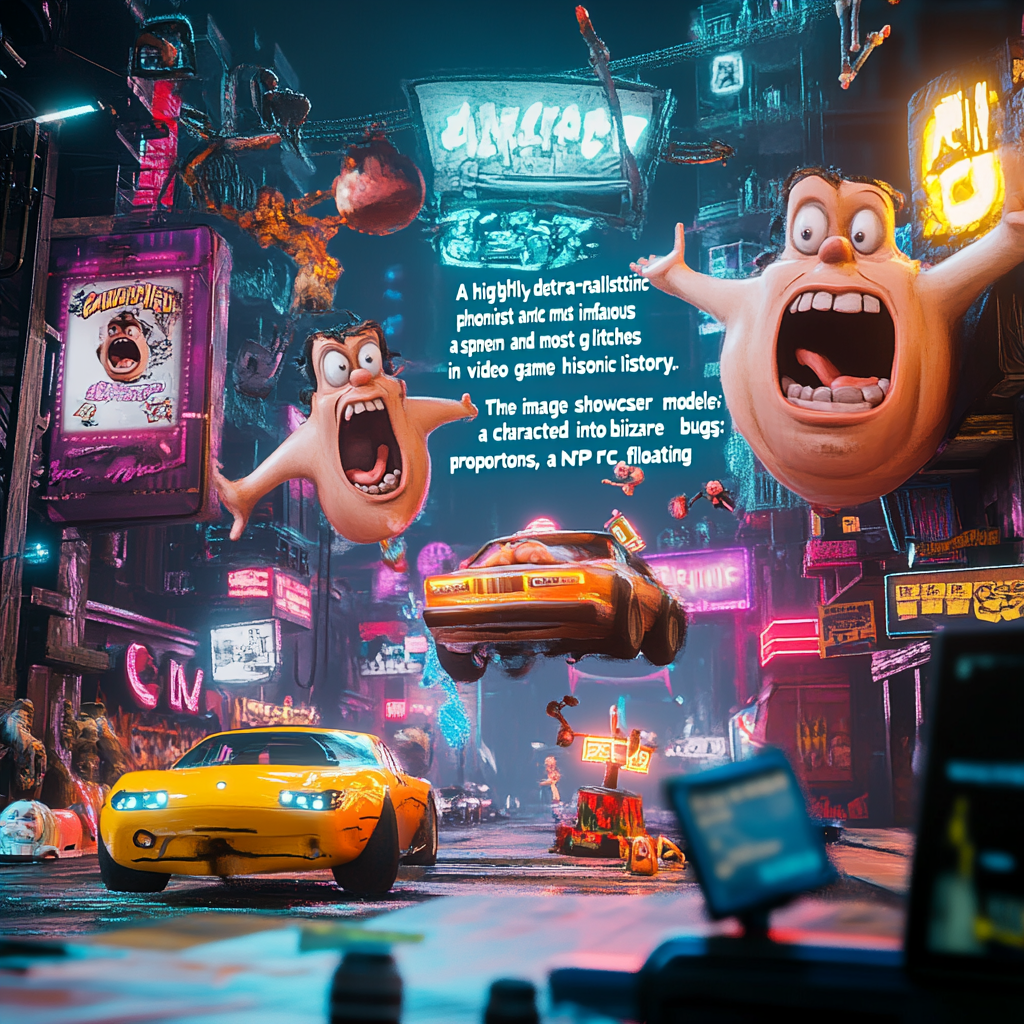
Introduction: How Coding Errors Become Gaming Legends
Today's video games are true digital blockbusters. With budgets rivaling Hollywood's and teams of hundreds of developers, these interactive works of art are the result of meticulous labor. However, the sheer complexity of their technical architecture creates a fascinating paradox: despite massive resources invested in quality assurance, programming errors are often what make history. These anomalies, commonly known as bugs or glitches, consistently manage to slip into the final product.
Far from being mere manufacturing defects, these malfunctions often lead to situations as unexpected as they are hilarious. Whether it's inexplicably flying characters, the sudden suspension of the laws of physics, or distorted 3D models, these bugs have transcended their status as technical errors. They have entertained millions of players and helped shape a unique gaming culture, where the unexpected becomes an essential part of the experience.
Key Takeaways
- Physics distortions turn serious sports simulations into absolute slapstick comedies.
- Collision errors in physics engines have created legendary flying scenes in open-world games.
- Teleportation glitches have been reclaimed by the community to revolutionize speedrunning.
- Not all bugs are fun: some malfunctions fundamentally destroy the player experience and corrupt save files.
Physical Distortions: Why Do Sports Games Generate the Most Absurd Bugs?
The video game industry invests massive resources to achieve striking visual realism, particularly in sports simulations. These titles rely on complex animation engines meant to faithfully replicate human anatomy and movement. It is precisely this quest for hyper-realism that makes modeling bugs so memorable and jarring for the player.
When the Simulation Loses Control
Sports games are subjected to countless real-time calculations to handle collisions between athletes, the ball, and the environment. When the physics engine gets its wires crossed, the visual result is often spectacular. As analyzed by the editorial team at Tom’s Hardware: "Like FIFA, Madden NFL is a relatively stable title that occasionally experiences moments of madness. Most often, these are bugs affecting character models, such as highly improbable body distortions, invisible players on the field, or a bug that drastically shrinks a player's size."
The Contrast Between Seriousness and Absurdity
The comedic impact of these errors lies in the glaring contrast between the game's serious, broadcast-style atmosphere and the sheer absurdity unfolding on screen. Watching an American football player suddenly shrink to eight inches tall while continuing to tackle normal-sized opponents creates a hilarious cognitive dissonance.
These scale anomalies and limbs stretched to the extreme demonstrate the limits of procedural animation algorithms. Instead of frustrating the community, these moments of technical delirium are often captured, shared on social media, and celebrated as genuine comic relief within an otherwise highly regimented virtual competition.
The Laws of Gravity Suspended: How Skyrim and Assassin’s Creed Made Their NPCs Fly
While body distortions amuse sports fans, adventure game players regularly face another category of anomaly: the complete breakdown of gravitational rules. In virtual environments, gravity isn't a natural law but a force simulated by a physics engine. When two objects collide unexpectedly, this engine must calculate a repulsive force. If the variables spiral out of control, the energy generated becomes astronomical.
The Space Dragon Syndrome
One of the most iconic examples of this faulty physics is found in The Elder Scrolls V: Skyrim. In this epic role-playing game, simple collisions between non-player characters (NPCs) and massive creatures spawn wildly disproportionate reactions. The community still fondly remembers giant attacks where club strikes sent the player's avatar soaring hundreds of feet into the air. Similarly, the sight of a majestic dragon taking flight with an NPC inexplicably glued to its tail sparked widespread hilarity and spawned countless compilation videos.
The Quantum Leaps of Assassin’s Creed
The phenomenon isn't limited to fantasy realms. Upon its release, Assassin’s Creed Unity made headlines with memorable bugs where characters seemed to completely ignore Earth's gravity. Players reported frequent instances where their avatar, Arno, was suddenly propelled into the sky after attempting to climb onto a balcony. These unforeseen moments turned tense stealth sequences into absurd comedy sketches, with the protagonist floating above Paris, defying all laws of dynamics.
Taking Flight in Los Santos
The Grand Theft Auto franchise has also delivered its fair share of involuntary flights. In Grand Theft Auto V, the community quickly discovered a glitch that allowed characters to launch into the air after being hit by a vehicle under very specific conditions. Dubbed the "Superman glitch," this collision flaw was heavily exploited by players to explore the map from a brand-new perspective. These calculation errors perfectly illustrate how a failure in physics simulation can actually enhance the entertainment value.
Teleportation Glitches: How Calculation Errors Become Strategic Tools for Speedrunners
Beyond physics errors, virtual worlds sometimes suffer from spatial positioning issues. Teleportation glitches occur when a character's coordinates are misinterpreted or corrupted by the system. These calculation errors instantly propel the avatar to the other side of the map or clip them through the level's solid geometry, sending them into the limbo of the out-of-bounds void.
The Rise of the Glitch Hunters
What began as a mere programming mistake quickly evolved into an endless playground. In certain open-world RPGs, it is not uncommon to see the community meticulously analyze every wall on the map in search of a vulnerability. A genuine subculture of specialized players, known as glitch hunters, has emerged. Their goal isn't to follow the story, but to bend the code to force the game to reveal its backstage areas and unfinished zones.
From Flaw to Speedrun
The impact of these teleportation glitches is especially visible in the worlds of esports and speedrunning. Competitive players have learned to surgically domesticate these spatial bugs. By exploiting precise collision mechanics, they manage to intentionally trigger teleports that shave precious minutes off their times, entirely skipping large chunks of the game's storyline.
This clever manipulation transforms a technical error into a genuine strategic tool. The bug is no longer something suffered by chance; it is triggered, mastered, and timed to the second. This reappropriation proves that the community isn't content with passively consuming a digital work. Instead, they actively interact with its flaws, creating a new, globally recognized form of technical performance.
The Dark Side: When Do Bugs Ruin the Gaming Experience (Ride to Hell & Zelda)?
While many anomalies bring a smile to our faces and enrich gaming culture, there is a much darker side to software malfunctions. When a bug stops being a mere visual quirk and attacks the very core of the gameplay, amusement instantly gives way to deep frustration. These fatal errors, aptly named game-breaking bugs, can ruin dozens of hours of personal investment.
Accidental Invincibility: The Case of Zelda
A classic example of this dark side can be found in certain versions of The Legend of Zelda: Ocarina of Time. Due to a programming flaw, an iconic monster named "Dead Hand" could suddenly become completely invincible. The player was left trapped in a closed arena, unable to defeat their opponent or flee. This type of dead end (a softlock) brings adventure progression to a screeching halt, forcing the player to reset their console and lose any unsaved progress.
Total Meltdown: The Example of Ride to Hell
However, some titles don't just suffer from an isolated bug, but rather a complete structural meltdown. Ride to Hell: Retribution is often cited as a prime example of a game with memorable bugs, but for the worst possible reasons. In this specific case, the anomalies aren't amusing exceptions; they are the core experience.
The player endures random crashes, unresponsive controls, and mission scripts that fail to trigger, making completing the game virtually impossible. This technical shipwreck illustrates the fundamental contrast in programming: an unexpected bug in a stable game (like the miniature player in Madden NFL) is comical, but a systemic accumulation of errors in a broken title like Ride to Hell quickly becomes a painful psychological ordeal.
Comparative Matrix: How to Evaluate a Bug's Impact in Your Game?
To understand how gaming culture processes these technical anomalies, it helps to categorize them analytically. The Video Game Anomaly Matrix allows us to instantly classify a malfunction along two fundamental axes: its entertainment potential (Comedic) and its danger level to the gaming session (Destructive).
| Category | Example Game | Bug Description | Comedic Potential | Destructive Impact |
|---|---|---|---|---|
| Bodily Distortion | Madden NFL | Tiny players or stretched limbs on the field. | Very High | Low (Visual only) |
| Physics Freakout | Skyrim | NPCs launched into the stratosphere after a club strike. | High | Moderate (Action interrupted) |
| Spatial Glitch | GTA V | The character goes flying after hitting a specific obstacle. | High | Low (Often intentional) |
| Event Lock | Zelda: Ocarina of Time | The "Dead Hand" boss becomes completely invincible. | Low | High (Progression blocked) |
| Structural Crash | Ride to Hell | Broken scripts, lost saves, incessant crashing. | None | Critical (Unplayable game) |
This table demonstrates that a bug's popularity relies on a delicate balance: it must be absurd enough to elicit a laugh, yet harmless enough not to wipe out the player's progress.
Frequently Asked Questions (FAQ): Understanding the Technical Behind-the-Scenes
Why do games release with bugs despite testing phases?
Creating a modern video game involves millions of lines of code and complex interactions between artificial intelligence, graphics, and physics. Quality Assurance (QA) teams hunt down errors, but it is mathematically impossible to predict exactly how a physics engine will behave when subjected to the millions of unpredictable actions players will take upon a global launch.
Do developers intentionally leave some glitches in?
Yes, sometimes they do. If a developer notices during testing that a physics anomaly doesn't hinder overall progression and makes the team laugh (like certain flying glitches in open-world games), they might decide to keep it. The bug then earns the unofficial status of a feature.
Can an in-game bug physically damage a console or PC?
In the vast majority of cases, no. A software bug (like a collision loop) might cause a severe slowdown or force the game to close abruptly (crash). However, modern operating systems have built-in safeguards to prevent an application from damaging the machine's hardware components.
Conclusion: Has Technical Imperfection Become a Digital Signature?
Video game bugs have transcended their status as mere development errors to become genuine cultural milestones. Whether it's the highly improbable anatomical distortions in Madden NFL, the unsanctioned flights in Skyrim, or absolute technical disasters like Ride to Hell, these anomalies tell the story of a technology pushed to its absolute limits.
Without these flaws, the history of the video game industry would be far too clinical, polished, and devoid of the unpredictability that forges the best community memories. Technical imperfections serve as a reminder that behind these mega-productions lie human programmers and chaotic mathematics.
What about you? Which digital malfunction left the biggest mark on your gaming sessions? Feel free to share your favorite bug and your most memorable anecdotes in the comments section below!